How to Check Card Centering
Everything you need to know about centering: what it is, how it’s measured, and what the grading companies require.
1. What Is Card Centering?
Centering refers to how evenly the printed image is positioned within the card’s borders. A perfectly centered card has equal border width on all four sides. A poorly centered card has noticeably more border on one side than the other.
Centering matters because it directly affects a card’s grade, its market value, and how desirable it is to other collectors. All major grading services (PSA, BGS, CGC) evaluate centering as part of their overall grade. A card with perfect corners, edges, and surface can still receive a lower grade if the centering is off. Many collectors won’t even consider a card with visibly poor centering, regardless of what the label says.
Why it matters financially: The difference between a PSA 10 and a PSA 9 on a high-value card can be hundreds or even thousands of dollars. Centering is often the deciding factor.
2. How Centering Is Measured
Centering is expressed as a ratio that compares the margins on opposite sides of the card. The margin is the space between the card’s edge and the printed area (the artwork, text, or design inside). Two measurements are taken:
- Left/Right (L/R): The left margin vs. the right margin.
- Top/Bottom (T/B): The top margin vs. the bottom margin.
For example, if the left margin measures 3mm and the right measures 2mm, the total is 5mm. The left accounts for 60% and the right 40%, giving you a 60/40 L/R ratio.
A perfectly centered card measures 50/50 on both axes, meaning equal margins on each side. The further a card drifts from 50/50, the worse the centering.
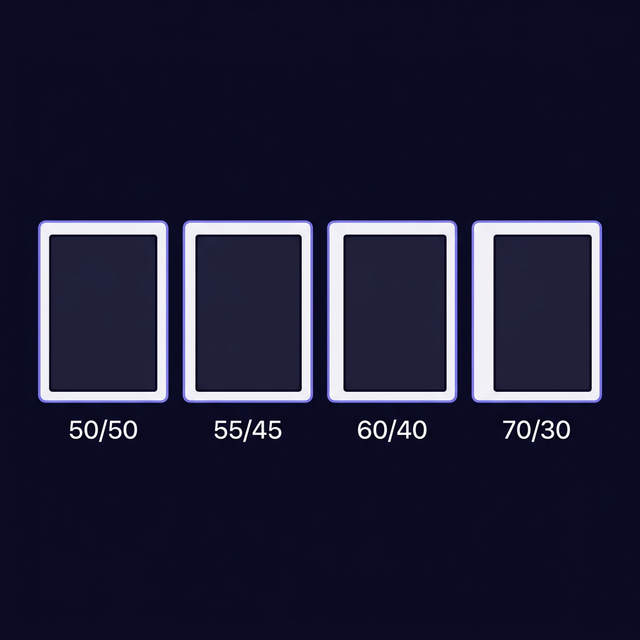
- 50/50 — Perfect centering. Equal margins on both sides. This is what every grading service considers ideal.
- 55/45 — Slightly off-center. Barely noticeable to the eye. Still qualifies for top grades at PSA and CGC.
- 60/40 — Noticeably off-center. You can see the printed area shifting toward one edge. Drops below PSA 10 territory.
- 70/30 — Significantly off-center. The margin difference is obvious. Limits the card to mid-range grades.
Grading services evaluate centering based on the worst axis: whichever of L/R or T/B is further from 50/50. A card that’s 50/50 left-right but 65/35 top-bottom would be graded on the 65/35.
3. Centering Requirements by Grading Service
Each grading service has different centering tolerances. The table below shows what centering grade your card qualifies for at each ratio. Front centering requirements are shown. Back centering is typically more lenient.
| Centering | PSA | BGS | CGC | SGC | TAG | ACE |
|---|---|---|---|---|---|---|
| 50/50 | 10 | 10 | 10P | 10P | 10P | 10 |
| 55/45 | 10 | 9.5 | 10 | 10 | 10 | 10 |
| 60/40 | 9 | 8.5 | 9.5 | 9 | 9 | 10 |
| 65/35 | 8 | 7 | 8.5 | 8.5 | 8 | 9 |
| 70/30 | 7 | 5 | 7 | 7.5 | 7 | 8 |
| 75/25 | 6 | 5 | 6 | 6 | 6 | 6 |
| 80/20 | 6 | 4 | 4.5 | 5 | 5 | 6 |
| 85/15 | 5 | 3 | 4.5 | 4 | 4 | 3 |
| 90/10 | 3 | 2 | 3.5 | 3 | 3 | — |
How to read this table: Find your card’s worst centering ratio in the left column, then read across to see the highest centering grade it qualifies for at each service. A ”—” means the card falls below that service’s minimum centering threshold.
A few things to note:
- BGS is the strictest at the top. A BGS 10 requires perfect 50/50 centering, and the grades drop fast. By 70/30, you’re already at a 5. BGS uses half-point increments (10, 9.5, 9, 8.5, etc.), where a half-point grade reflects characteristics of both the level above and below.
- PSA is more forgiving at the top end. PSA 10 allows up to 55/45, which means slightly off-center cards can still gem.
- ACE is uniquely lenient. A 60/40 card still qualifies for an ACE 10, making it the most forgiving service for centering at the top grades.
- CGC and SGC use Pristine tiers (10P) that require perfect 50/50 centering on both front and back.
- TAG has the most granular scale with half-point grades all the way down (7.5, 6.5, 5.5, etc.), giving you a finer picture of where your card stands. Only whole-point grades are shown in the table above for readability.
- Back centering thresholds are more lenient across all services. For example, PSA allows up to 75/25 on the back for a 10, compared to 55/45 on the front.
Deep Dive into BGS Limits: Want to see the real data behind BGS centering subgrades? 155 slabs measured, one clear pattern. Read the full breakdown.
4. Methods for Checking Centering
There are several ways to check a card’s centering, each with trade-offs:
Eyeballing it. Quick but unreliable. The human eye is surprisingly bad at judging small differences in border width, especially on cards with dark or busy borders.
Ruler or caliper. Accurate, but tedious. You’re measuring sub-millimeter differences, and there’s always a risk of damaging the card with physical tools.
Centering apps. Convenient and fast. Most apps work by having you place borders on a photo of the card. The accuracy depends heavily on the quality of the photo. A tilted or angled image will produce misleading ratios.
The biggest challenge with photo-based measurement is perspective distortion. When you photograph a card at an angle, the borders on the far side of the card appear narrower than they actually are. This makes centered cards look off-center, and off-center cards look worse than they are. This is why checking card centering from an angled photo without correction leads to misleading results.
Apps that correct for perspective — like Rectifi — straighten the card image first, then measure centering, producing reliable ratios regardless of the camera angle. This is the key to getting accurate straight card centering measurements from any photo.
5. Checking Centering from Online Listings
If you’re buying raw cards online, checking centering before you buy is critical. A card that looks centered in a listing photo might not be, and you won’t know until it arrives and you’ve already spent the money.
The problem with listing photos:
- Sellers rarely photograph cards perfectly flat and overhead.
- Cards are often shot at angles, in cases, or in stacks.
- Perspective distortion makes it nearly impossible to judge centering by eye from a listing photo.
This is where centering analysis from photos becomes most valuable. If you can run a listing photo through a tool that corrects for perspective and gives you actual ratios, you can make an informed decision before you buy, not after.
The bottom line: If you’re spending real money on raw cards — whether at a card show, on eBay, or in a group break — checking centering before you buy is the cheapest insurance you can get.
Want to know more about why this tool exists? Read the story behind Rectifi.
Don’t Get Burned on Bad Centering
Rectifi analyzes card centering from any photo, even listing photos taken at an angle. Free on iOS.
Try Rectifi